Apr 30, 2026
How FIFA-Certified Football Turf Changed the Game — and What It Means for Canada
Table of Contents
- What Is FIFA-Certified Football Turf?
- FIFA Quality vs FIFA Quality Pro: What's the Difference?
- How FIFA-Certified Turf Changed Modern Stadiums?
- Why FIFA-Certified Turf Matters in Canada?
- FIFA Turf vs Natural Grass vs Regular Artificial Turf
- FIFA Turf Standards You Should Know
- Choosing the Right Turf for Your Canadian Football Facility
- How Pro Green Turf & Design Installs Sports Turf in BC
- Frequently Asked Questions: FIFA-Certified Football Turf in Canada
- Frequently Asked Questions About Pro Green Turf & Design
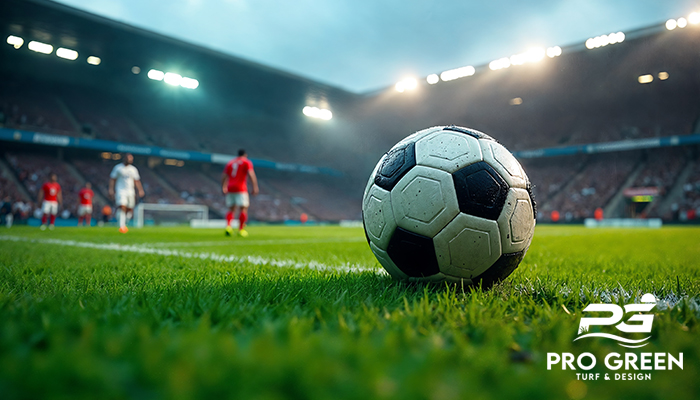
If you follow football — or soccer, as we call it in Canada — you’ve probably noticed that the pitches at top tournaments look and play differently from a school field or community park. A big reason for that? FIFA-certified football turf.
Since the early 2000s, FIFA has developed and enforced a strict certification program for artificial football turf. Today, FIFA-certified turf is the standard at World Cup venues, professional training facilities, and an increasing number of community fields across Canada. In this guide, we break down exactly what FIFA certification means, what it’s changed, and how it applies to football facilities being built across BC and Canada.
What Is FIFA-Certified Football Turf?
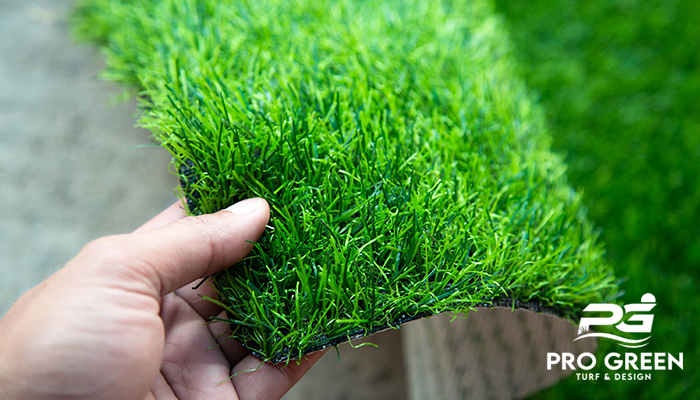
FIFA-certified turf refers to artificial grass products that have passed a rigorous independent testing and certification process managed by FIFA — the Fédération Internationale de Football Association, the global governing body for the sport.
To earn FIFA certification, artificial turf must meet strict performance standards covering player safety, ball behaviour, surface durability, and environmental impact. Testing is conducted by independent, FIFA-accredited laboratories—not by the manufacturer. This matters a lot because it means no manufacturer can simply claim their turf is FIFA-certified without actually proving it.
The certification program has two levels:
- FIFA Quality — suitable for community, school, and amateur club use
- FIFA Quality Pro — required for professional competitions and international events like the World Cup
Canada Connection: Canada Soccer, the national governing body for the sport in Canada, recognizes FIFA turf standards for all sanctioned competitions. Schools, clubs, and municipalities building football fields in BC and across Canada increasingly specify FIFA-certified turf to meet eligibility requirements for competitive play.
FIFA Quality vs FIFA Quality Pro: What's the Difference?
The two levels of FIFA certification serve different needs. Here’s a clear breakdown:
| Feature | FIFA Quality | FIFA Quality Pro |
|---|---|---|
| Best For | Schools, community clubs, amateur leagues | Professional clubs, international venues |
| Daily Use | Up to 8 hours per day | 10+ hours per day |
| Annual Games | Up to 150 games per year | Unlimited — professional schedule |
| Typical Lifespan | 6–8 years | 8–12 years |
| World Cup Eligible | No | Yes — designated standard |
| Cost | Lower upfront investment | Higher upfront, lower long-term cost |
| Examples | School fields, municipal parks | MLS training pitches, national stadiums |
Practical Tip for Canada: If you’re building a community football pitch in Vancouver, Surrey, or Langley that will be used for city leagues and provincial tournaments, FIFA Quality is a high-qulaity, cost-effective choice. If you’re building a dedicated training facility or a venue intended for national-level competition, FIFA Quality Pro is what you want.
How FIFA-Certified Turf Changed Modern Stadiums?
It’s easy to forget how different football pitches used to be. Before high-quality artificial turf entered the picture, stadium managers faced a constant battle with weather, heavy usage, and inconsistent playing surfaces. Here’s what changed.
Before FIFA Certification: The Problems with Natural Grass
Natural grass looks beautiful — but it’s an operational nightmare at scale. Heavy rain turns pitches into mud. High usage leads to bare patches and uneven surfaces. Maintenance costs are enormous: watering, mowing, fertilizing, re-seeding, and sometimes replacing entire pitches. At the 2022 FIFA World Cup in Qatar, summer temperatures hit 50°C — and the survival rate of natural grass fields in those conditions was below 30%.
Natural grass needs managed recovery time to avoid surface degradation. That’s a real problem when a stadium is trying to host multiple events or support a team that trains twice a day.
What FIFA Turf Changed
FIFA-certified artificial turf addressed almost every one of those problems:
- All-weather playability: FIFA-certified turf can be played on within 15 minutes of heavy rain, with drainage rates of 30mm per hour or more required as part of certification.
- Consistent surface: No bare patches, no mud, no variation based on how much traffic the pitch has seen this week. The ball rolls and bounces predictably every time.
- Massive reduction in maintenance costs: No watering, no mowing, no fertilizing. FIFA-certified turf saves facilities roughly 60% in ongoing maintenance costs compared to natural grass.
- Extended usability: A FIFA-certified pitch can handle eight or more hours of high-intensity training per day without surface degradation. Natural grass simply can’t match that.
- Longer lifespan: Regular artificial turf lasts 3–5 years. FIFA-certified turf is built to last 8–12 years under normal professional use.
Impact on the World Cup
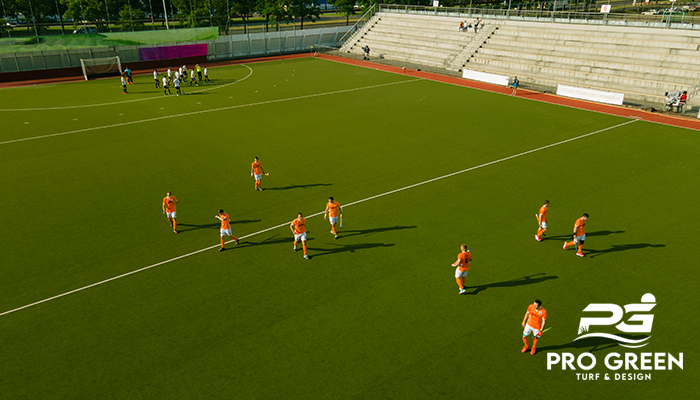
At the 2022 FIFA World Cup in Qatar, five major venues used FIFA football turf for training. The training grounds of all 32 teams at the 2026 FIFA World Cup — being co-hosted by Canada, the United States, and Mexico — will use 100% FIFA-certified artificial turf. Some venues use mixed grass systems, but the FIFA-certified turf component is non-negotiable for training grounds.
This is a massive endorsement. When the world’s best footballers train on a surface every day leading up to the biggest tournament on Earth, you know that surface was designed to perform.
Why FIFA-Certified Turf Matters in Canada?
Canada is having a genuine football moment. The men’s national team qualified for the 2022 World Cup for the first time in 36 years, and Canada is a co-host of the 2026 World Cup. Youth football participation is growing rapidly. More facilities, more clubs, and more communities across BC and Canada are investing in football infrastructure.
Against that backdrop, FIFA-certified football turf is more relevant in Canada than ever before.
Climate: Canada’s Unique Challenge
Canada’s climate creates specific challenges for outdoor football facilities. In BC’s Lower Mainland and Fraser Valley, the wet season runs from October through April — prime football training time. Annual rainfall in Metro Vancouver hits 1,200–1,600mm. Natural grass in these conditions requires expensive drainage work, constant maintenance, and still often becomes unplayable for weeks at a time.
FIFA-certified turf is designed with drainage rates of at least 30mm per hour. That means a pitch in Langley or Surrey can be fully playable within 15 minutes of heavy rain stopping — no closures, no muddy sessions, no cancelled training.
Eligibility for Competitions
An increasing number of Canadian soccer leagues and tournaments require pitches to meet FIFA or CSA (Canada Soccer Association) turf standards for competitive eligibility. If you’re building a facility that you want clubs, leagues, or provincial organizations to use for competitive matches, confirming that your surface meets these standards upfront saves you from costly retrofits later.
Schools and Municipal Facilities in Canada
Canadian school boards and municipalities are increasingly specifying FIFA-certified or FIFA-equivalent turf for new football field builds. The combination of reduced maintenance costs, all-weather usability, player safety standards, and long lifespan makes the economics very compelling for publicly funded facilities that need to serve communities for 10+ years.
Did You Know? The 2026 FIFA World Cup is being co-hosted by Canada. Canadian cities including Vancouver and Toronto are involved in the tournament. This has accelerated investment in FIFA-standard football infrastructure across the country, with schools, clubs, and municipalities all looking to upgrade their facilities.
FIFA Turf vs Natural Grass vs Regular Artificial Turf
It’s worth putting the three options side by side so you can see exactly where FIFA-certified turf sits in the landscape.
| Factor | Natural Grass | Regular Artificial Turf | FIFA-Certified Turf |
|---|---|---|---|
| Lifespan | 2–3 years before renovation | 3–5 years | 8–12 years |
| Maintenance Cost | High (watering, mowing, seeding) | Low | Very low |
| All-Weather Use | No — closes after heavy rain | Yes | Yes — playable within 15 min of rain |
| Player Safety | Variable | Not independently tested | Strictly tested (shock, friction, deformation) |
| Ball Performance | Variable by condition | Inconsistent | Consistent, close to natural grass |
| Carbon Footprint | High (water, chemicals, equipment) | Moderate | 82% lower than natural grass |
| Competition Eligible | Yes (where maintained) | Generally no for top competitions | Yes — required for FIFA events |
| Upfront Cost | Low–Moderate | Moderate | Higher upfront, lower over lifespan |
FIFA Turf Standards You Should Know
If you’re specifying or purchasing turf for a football facility in Canada, here are the key technical standards FIFA tests for and why each one matters.
Player Safety Standards
- Shock Absorption: Turf must reduce the impact energy when a player lands or falls. This is critical for protecting knees, ankles, and hips, especially on the hard sub-bases common in Canada.
- Vertical Deformation: The surface must cushion like natural grass, not feel like concrete. FIFA requires 6–10mm of vertical deformation under standard testing, giving players a natural feel underfoot.
- Rotational Resistance: The amount of torque between a player’s cleats and the surface. FIFA-certified turf must deliver a torque range of 25–50 Nm. That’s enough grip to play safely, but not so much that the foot locks and causes knee injuries.
Ball Performance Standards
- Ball Roll: Controls how far a ball rolls, simulating professional playing conditions. FIFA-certified turf must deliver consistent ball roll within a defined range that matches that of natural grass.
- Ball Bounce: The ball must rebound to a height between 0.6 and 1.0 metres when dropped from 2 metres. This ensures a predictable, game-realistic bounce.
- Friction: The friction between ball and surface must fall within a defined range to ensure comfortable, abrasion-free play.
Durability and Environmental Standards
- UV Resistance: FIFA-certified turf must pass accelerated aging tests of at least 3,000 hours without significant degradation. Standard artificial turf is typically tested to 1,500 hours, half as much.
- Drainage: Minimum 30mm per hour drainage rate. This is critical for Canadian football facilities, which must contend with BC’s rainy winters.
- Environmental Safety: All materials must meet environmental standards, ensuring no harmful substances are released from the turf fibres or infill.
Choosing the Right Turf for Your Canadian Football Facility
Not every football project needs FIFA Quality Pro. Here’s a practical framework for matching the right turf specification to your project.
| Project Type | Recommended Spec | Notes |
|---|---|---|
| School or university football field (BC) | FIFA Quality | All-weather usability, player safety, competition eligibility for school leagues |
| Municipal community park field | FIFA Quality | Long lifespan justifies investment for publicly funded facility |
| Amateur club training ground | FIFA Quality | Supports eligibility for provincial league competition |
| Professional club training facility | FIFA Quality Pro | Handles 10+ hours/day use; required for professional standards |
| National competition venue | FIFA Quality Pro | Required standard for Canada Soccer-sanctioned competitions |
| Backyard or small recreational area | Standard sports turf | FIFA certification not required or cost-effective at this scale |
Action Step: Before you finalize any football field project in Canada, check with your provincial soccer association (e.g., BC Soccer) about specific turf requirements for the competitions you plan to host. Getting this right from day one prevents expensive surface upgrades later.
How Pro Green Turf & Design Installs Sports Turf in BC
At Pro Green Turf & Design, sports court and sports turf installation is one of our core services. We build high-performance playing surfaces for schools, clubs, municipalities, and private facilities across the Lower Mainland, Fraser Valley, Vancouver Island, and Okanagan Valley.
Here’s what working with Pro Green looks like on a football turf project.
Step 1: Free Consultation & Site Assessment
Every project starts with a free consultation. We visit your site, assess the existing surface and drainage, discuss your usage requirements (hours per day, types of events, competition eligibility needs), and recommend the right turf specification. We’ll also flag any sub-base, grading, or drainage work needed before installation begins, so there are no surprises.
Step 2: Sub-Base & Drainage Preparation
The sub-base is the foundation of any sports turf installation, and it’s especially important in BC, where drainage is critical. Our team excavates, grades, and compacts the sub-base, installs drainage layers as needed, and ensures the surface is level and stable before turf goes down. This is the step that separates a surface that lasts 10+ years from one that fails within a few seasons.
Step 3: Turf Installation
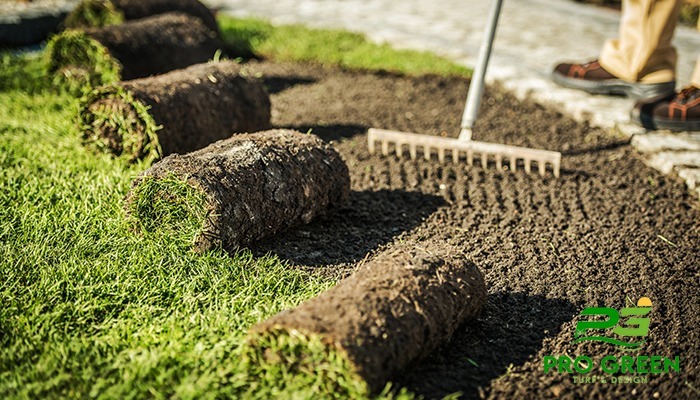
We source and install premium sports turf products that meet your project specifications. Whether you need a FIFA-equivalent community football pitch or a multi-sport synthetic surface, we handle the full installation — laying, seaming, securing, and infilling to the correct depth and density for your application.
Step 4: Line Marking & Finishing
All pitch markings — touchlines, goal areas, penalty areas, centre circles, and penalty spots — are applied accurately using durable, UV-resistant paint or inlaid coloured turf sections. We work to your league’s specific pitch dimension requirements.
Step 5: Quality Check & Handover
Before we hand over the completed pitch, we conduct a thorough quality check: surface evenness, drainage, line accuracy, and infill consistency. We’ll walk you through basic maintenance requirements, including periodic brushing and occasional infill top-up, to keep the surface performing at its best for years.
Serving BC: Pro Green Turf & Design serves Vancouver, Langley, Surrey, Burnaby, Richmond, Coquitlam, Delta, Maple Ridge, and all across BC’s Lower Mainland, Fraser Valley, Vancouver Island, and Okanagan Valley.
Ready to Build a FIFA-Grade Football Pitch in Canada?
Get a free, no-obligation quote from Pro Green Turf & Design. Serving Vancouver, Langley, Surrey, Burnaby, Coquitlam & All Across BC progreenlandscape.ca | 604-442-5000 | info@progreenlandscape.ca
Frequently Asked Questions: FIFA-Certified Football Turf in Canada
Q: What is FIFA-certified football turf?
FIFA-certified football turf is artificial grass that has passed independent testing by FIFA-accredited laboratories and meets strict standards for player safety, ball performance, durability, and environmental impact. There are two grades: FIFA Quality (for community and amateur use) and FIFA Quality Pro (for professional and international competition).
Q: Is FIFA-certified turf required for football fields in Canada?
It depends on the level of competition. Canada Soccer and provincial associations like BC Soccer increasingly require FIFA-certified or FIFA-equivalent surfaces for sanctioned competitions. Community and recreational fields don’t strictly require it, but the performance and safety benefits make it a smart investment for any serious facility.
Q: What is the difference between FIFA Quality and FIFA Quality Pro?
FIFA Quality is designed for community, school, and amateur club use — typically up to 8 hours of use per day and around 150 games per year. FIFA Quality Pro is built for professional clubs and international venues and can handle 10+ hours of daily use. FIFA Quality Pro turf is the designated standard for World Cup and other elite competitions.
Q: How long does FIFA-certified turf last in Canada’s climate?
FIFA-certified turf typically lasts 8–12 years under normal use. In BC’s wet climate, proper sub-base drainage is critical to achieving maximum lifespan. FIFA-certified turf is tested to a minimum of 3,000 UV-resistance hours, far exceeding standard artificial turf’s 1,500-hour minimum.
Q: Is FIFA-certified turf safe for players?
Yes — player safety is one of the core pillars of FIFA certification. Certified turf must pass rigorous testing for shock absorption, rotational resistance, and vertical deformation to ensure it cushions falls and reduces the risk of injury to knees, ankles, and hips.
Q: Can FIFA-certified turf be used right after rain?
Yes. FIFA certification requires a minimum drainage rate of 30mm per hour. In practice, this means a FIFA-certified pitch, even in BC’s rainy climate, will typically be fully playable within 15 minutes of heavy rainfall stopping. This is a major advantage over natural grass, which often takes days to recover after heavy rain.
Q: How do I verify if a turf product is genuinely FIFA certified?
Ask the supplier for the FIFA certification certificate, which includes a unique certificate number and the name of the accredited testing laboratory. You can verify the certificate by searching the FIFA Certification Inquiry Platform online — look for an ‘Active’ status. Be cautious of suppliers offering only partial or expired certifications.
Q: Is FIFA-certified turf better for the environment?
Compared to natural grass, FIFA-certified turf has an 82% lower carbon footprint over its lifespan, mainly because it eliminates watering, mowing, fertilizing, and frequent renovation. Compared to standard artificial turf, it also lasts significantly longer — meaning less material waste over time. Many modern FIFA-certified products also use recyclable materials.
Q: How much does it cost to install a FIFA-certified football pitch in Canada?
Costs vary based on pitch size, sub-base work required, and the specific turf product. A full-size FIFA football pitch (68m x 105m) is a significant investment, but the 8–12 year lifespan and reduced maintenance costs make it competitive with natural grass over the full lifecycle. Pro Green offers free site consultations and detailed quotes — contact us to get accurate pricing for your specific project.
Frequently Asked Questions About Pro Green Turf & Design
Q: Who is Pro Green Turf & Design?
Pro Green Turf & Design is a BC-based outdoor design and installation company specializing in artificial turf, sports courts, putting greens, rubber playground tiles, concrete paving stones, artificial walls, and landscaping. We serve the Lower Mainland, Fraser Valley, Vancouver Island, and Okanagan Valley, and have completed 250+ projects for residential and commercial clients across BC.
Q: Does Pro Green install sports turf for football fields?
Yes. Sports court and sports turf installation is one of our core services. We design and build synthetic sports surfaces for schools, clubs, municipalities, and commercial properties. Our team handles the full process from sub-base preparation to turf installation and line marking.
Q: What areas does Pro Green Turf & Design serve in Canada?
We serve clients across BC, including Vancouver, Langley, Surrey, Burnaby, Richmond, Coquitlam, Delta, Maple Ridge, and surrounding communities. We cover the Lower Mainland, Fraser Valley, Vancouver Island, and Okanagan Valley.
Q: Can Pro Green install FIFA-grade turf for my football facility?
Pro Green works with premium sports turf products and can install surfaces appropriate for your specification — including FIFA-equivalent community pitches. We’ll help you determine the right product for your usage requirements and budget. Contact us for a free consultation.
Q: How do I get a quote from Pro Green for a football pitch?
Getting a quote is completely free. Visit progreenlandscape.ca and fill out the free quote form, or call us at 604-442-5000. We’ll schedule a site visit, assess your space, and provide a detailed written quote with no obligation.
Q: Can Pro Green combine a sports pitch with artificial turf surrounds?
Absolutely. Many facilities combine a hard-line sport surface with surrounding artificial turf for a complete outdoor recreation environment. Pro Green handles both the sports surface and the surrounding landscape, so you get a seamless, professional result from a single contractor.
Q: Is Pro Green’s work guaranteed?
Yes. Pro Green Turf & Design backs its work and uses quality materials that are designed to perform in BC’s climate. We have a strong track record of 5-star Google reviews and 150+ completed projects. Talk to us about specific warranty terms for your project.
Let’s Build Something Great
Pro Green Turf & Design — BC’s Sports Turf & Landscaping Specialists progreenlandscape.ca | 604-442-5000 | info@progreenlandscape.ca