Apr 28, 2026
Basketball Court Dimensions in Canada: Your Complete 2026 Guide
Table of Contents
- Why Basketball Court Dimensions Matter in Canada
- Standard Basketball Court Sizes: FIBA, NBA & High School
- Canadian-Specific Guidelines You Should Know
- Half-Court & Backyard Basketball Court Dimensions
- Court Lines & Markings Explained
- Choosing the Right Court Surface for Canada's Climate
- How Pro Green Builds Your Basketball Court
- Frequently Asked Questions: Basketball Court Dimensions in Canada
- Frequently Asked Questions About Pro Green Turf & Design
So you want to build a basketball court — great idea! But before you start pouring concrete or laying sport tiles, you need to get the dimensions right. A court that’s even a foot or two short can ruin the feel of the game, throw off your three-point shooting range, and may not meet local bylaws or sports federation rules.
Why Basketball Court Dimensions Matter in Canada
So you want to build a basketball court — great idea! But before you start pouring concrete or laying sport tiles, you need to get the dimensions right. A court that’s even a foot or two short can ruin the feel of the game, throw off your three-point shooting range, and may not meet local bylaws or sports federation rules.
In Canada, basketball courts follow FIBA (Fédération Internationale de Basketball) standards for both official and community-level play. Most provincial sports bodies follow these guidelines. Whether you’re a homeowner in Langley adding a backyard court, a school in Surrey building recreational space, or a facility manager constructing a competition court in Vancouver, getting the dimensions right from day one saves time, money, and frustration.
Good to know: Canada Basketball, the national governing body, follows FIBA regulations for all sanctioned games. If you’re building any court intended for organized league play, FIBA dimensions are the ones to follow.
Standard Basketball Court Sizes: FIBA, NBA & High School
Different organizations use slightly different court sizes. Here’s a breakdown of the most important ones, and which matters most for your project in Canada.
FIBA Dimensions (International Standard — Used Across Canada)
FIBA is the global governing body for basketball. Their court size is the standard used across Canadian community leagues, school competitions, and provincial tournaments. It’s slightly smaller than an NBA court, which is ideal for recreational and youth play.
| Court Level | Length | Width | Use Case |
|---|---|---|---|
| FIBA International | 28 m (91.86 ft) | 15 m (49.21 ft) | National & international competition |
| FIBA Club / Community | 26–28 m | 14–15 m | School gyms, community centres |
| NBA (North American Pro) | 28.65 m (94 ft) | 15.24 m (50 ft) | Professional leagues |
| High School (Canada) | 28.65 m (94 ft) | 15.24 m (50 ft) | Canadian high school sport |
| Junior High / Middle School | ~25.60 m (84 ft) | 15.24 m (50 ft) | Youth development leagues |
FIBA Key Measurements at a Glance
| Measurement | Metric | Imperial |
|---|---|---|
| Court Length | 28 metres | 91.86 ft |
| Court Width | 15 metres | 49.21 ft |
| Rim Height | 3.05 metres | 10 ft |
| Minimum Ceiling Height | 7 metres | 22.96 ft |
| Centre Circle Diameter | 3.6 metres | 11.8 ft |
| 3-Point Arc Radius | 6.75 metres | 22.14 ft |
| Key (Lane) Width | 4.9 metres | 16.1 ft |
| Restricted Area Radius | 1.25 metres | 4.1 ft |
NBA Court Dimensions
For a pro-style court — whether for a private training facility or because you just want the real deal — NBA dimensions are 94 ft long by 50 ft wide. It’s a bit larger than FIBA, so plan your space accordingly if you’re going this route.
High School Courts in Canada
Most Canadian high school courts match NBA dimensions at 94 ft x 50 ft. However, many existing school gyms were built to FIBA specs (28 m x 15 m). Both are fine for high school play. Check with your provincial sports association for any specific requirements in your area.
Pro Tip: If you’re building a backyard or recreational court and aren’t sure which size to go with, FIBA dimensions (28 m x 15 m) are the best all-around choice. They meet international standards and work for players of all ages.
Canadian-Specific Guidelines You Should Know
Building a basketball court in Canada isn’t just about the playing surface — there are a few local considerations that can affect your build.
Run-Off Space (Safety Buffer)
FIBA recommends a safety buffer zone around the court. For competition courts, you’ll want at least 2 metres of clear space on each sideline and 3 metres behind each baseline. This means the total footprint for a full FIBA court is closer to 34 m x 19 m once run-off space is included. For recreational and backyard courts, even 1 metre of clearance on each side makes a big practical difference.
| Zone | FIBA Recommendation | Practical Minimum |
|---|---|---|
| Sideline buffer | 2 metres | 1 metre |
| Baseline (behind basket) buffer | 3 metres | 2 metres |
| Total footprint (full court) | ~34 m x 19 m | ~30 m x 17 m |
Municipal Permits & Zoning
Before you start construction, check with your local municipality. In most BC cities, including Vancouver, Langley, Surrey, Burnaby, and Coquitlam, an outdoor sport court requires a building permit, especially if it includes a poured concrete base or permanent structures such as backboards. Residential bylaws may also have setback requirements, meaning your court can’t be within a certain distance of property lines or fences. Pro Green can guide you through this process.
Drainage Requirements
The level of rainfall in BC’s Lower Mainland and Fraser Valley means proper drainage is critical. A court that pools water after rain is unplayable and causes surface degradation over time. Proper sub-base installation and a surface with adequate permeability or slope are non-negotiable for outdoor courts in Canada.
BC-Specific Note: Metro Vancouver and the Fraser Valley receive 1,100–1,800 mm of rain per year depending on location. If you’re building an outdoor court in Langley, Surrey, or Coquitlam, drainage planning is just as important as getting the dimensions right.
Half-Court & Backyard Basketball Court Dimensions
Don’t have the space — or budget — for a full court? A half-court is a fantastic option and by far the most popular choice for Canadian homeowners adding a court to their backyard or driveway.
Standard Half-Court Size
A regulation half-court is half of a full court. Based on FIBA dimensions, that’s roughly 14 m x 15 m (about 46 ft x 49 ft). For a comfortable setup, aim for a minimum of 47 ft x 50 ft (about 14.3 m x 15.2 m)
| Court Type | Dimensions (m) | Dimensions (ft) | Best For |
|---|---|---|---|
| Full Court (FIBA) | 28 x 15 m | 91.86 x 49.21 ft | Competition, community centre |
| Half-Court (Standard) | 15 x 14 m | 50 x 46 ft | Backyard, recreational play |
| Compact Backyard | 10 x 7 m | 32.8 x 23 ft | Small yards, casual shooting |
| Mini / Kids Court | 9 x 5 m | 29.5 x 16.4 ft | Young children, driveway |
| 3×3 Basketball (FIBA) | 15 x 11 m | 49.2 x 36 ft | 3-on-3 format, outdoor parks |
Court Lines & Markings Explained
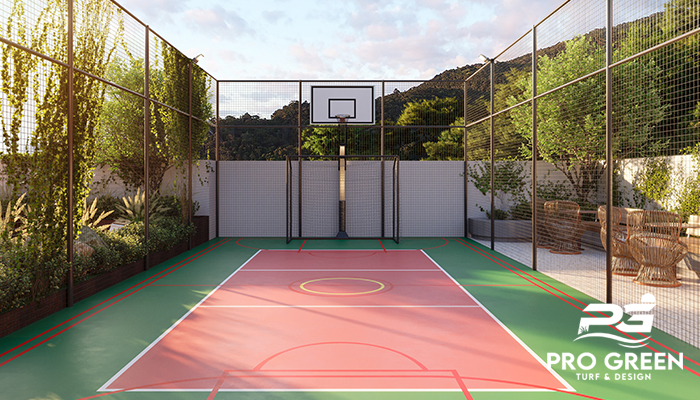
Lines aren’t just decoration; they define the rules of the game. Here’s a plain-English breakdown of all the key markings on a Canadian basketball court, based on FIBA standards.
Boundary Lines: Sidelines & Baselines
The sidelines run along the 28-metre length of the court. The baselines (also called endlines) run along the 15-metre width behind each basket. These four lines define the outer boundary of the playing area.
Centre Circle
The circular court in the middle of the court has a diameter of 3.6 m (11.8 ft). It’s used for tip-offs at the start of a game. The centre line runs across the full width of the court at the halfway point.
The Key (Free Throw Lane)
The rectangular painted area under each basket is called the key or free-throw lane. Under FIBA rules, the key is 4.9 m wide and 5.8 m long. The free throw line sits at the top of the key, 4.6 m from the backboard.
Three-Point Line
The arc curving around each basket is the three-point line. Under FIBA rules, it sits 6.75 m from the centre of the basket. In the corners, the line runs straight parallel to the baseline. Shots from beyond this arc are worth three points.
Restricted Area Arc (No-Charge Zone)
The small arc near the basket — with a 1.25 m radius from the centre of the hoop under FIBA rules — defines the no-charge zone. If a defensive player is inside this arc when contact occurs, they cannot draw a charging foul.
| Court Marking | FIBA Dimension | NBA Dimension |
|---|---|---|
| Free Throw Line | 4.6 m from backboard | 4.57 m from backboard |
| 3-Point Arc Radius | 6.75 m | 7.24 m (23.75 ft) |
| Key Width | 4.9 m | 4.88 m (16 ft) |
| Key Length | 5.8 m | 5.79 m |
| Centre Circle Diameter | 3.6 m | 3.66 m |
| Restricted Area Radius | 1.25 m | 1.22 m (4 ft) |
| Hoop Height | 3.05 m (10 ft) | 3.05 m (10 ft) |
Choosing the Right Court Surface for Canada's Climate
Canada’s weather is no joke, and your court surface needs to handle it. Here’s what you need to know about the main surface options and how they perform in BC and across Canada.
Concrete
Concrete is the most common choice for outdoor courts in Canada. It’s durable, long-lasting, and provides a consistent playing surface. It can be hard on joints over time and is prone to cracking in freeze-thaw cycles if not properly installed with control joints. Always use a properly compacted sub-base before pouring.
Asphalt
Asphalt is a budget-friendly option that handles Canada’s climate reasonably well. It’s more flexible than concrete and less prone to cracking from frost heave. It softens in very hot weather and has a shorter lifespan than concrete.
Sport Tiles (Interlocking Polypropylene)
Snap-together sport tiles are increasingly popular for residential and commercial courts in Canada. They’re quick to install, allow excellent drainage, provide cushioning underfoot, and can be laid over concrete or asphalt. They handle UV exposure and temperature swings well.
Synthetic Turf Surrounds
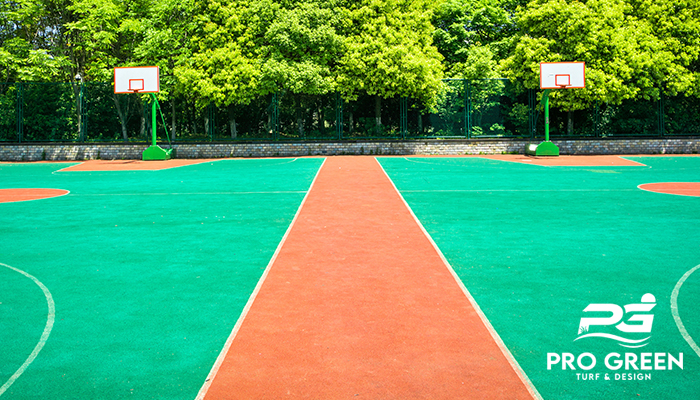
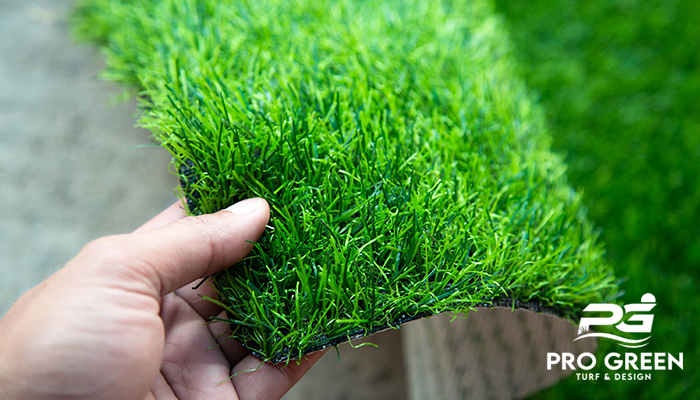
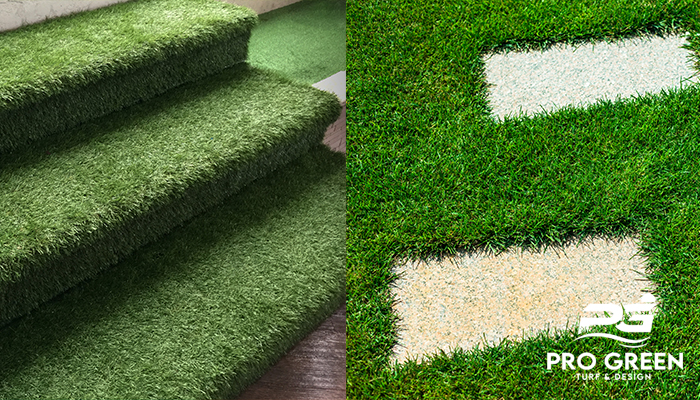
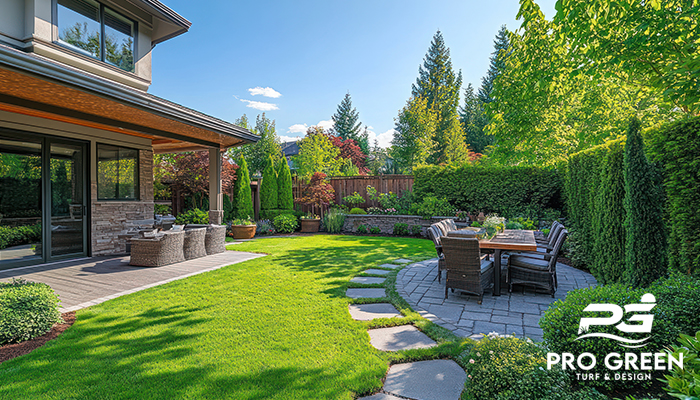
If you want a multi-use outdoor space, for example, a basketball court combined with other activities, synthetic turf from Pro Green Turf & Design can be installed in the surrounding areas. Many Canadian schools and community centres are combining hard-surface courts with artificial turf surrounds to create complete recreational areas that look great and perform year-round, even through BC’s wet winters.
Key surface considerations at a glance:
- Concrete: Most durable, 20–30 year lifespan, requires control joints for frost protection
- Asphalt: Budget-friendly, flexible, handles freeze-thaw cycles well
- Sport tiles: Fast installation, excellent drainage, cushioned underfoot feel
- Acrylic line paint with UV sealer: Best for visibility and weather resistance outdoors
- Artificial turf surrounds: Year-round green look, ideal for BC’s wet climate
How Pro Green Builds Your Basketball Court
At Pro Green Turf & Design, we’ve been building high-performance sports courts and outdoor spaces for homeowners, schools, and businesses across the Lower Mainland, Fraser Valley, Vancouver Island, and Okanagan Valley. Here’s what our process looks like.
Step 1: Free Consultation & Site Assessment
We start with a free site visit and consultation. We’ll measure your available space, discuss which court dimensions work best for you (full court, half-court, or custom), and walk you through surface and line-marking options. We’ll also flag any drainage or grading work needed before the base goes in, so there are no surprises later.
Step 2: Sub-Base Preparation
A court is only as good as what’s underneath it. Our team excavates, grades, and compacts the sub-base to ensure proper drainage and a level playing surface. This step is what separates a court that lasts 20+ years from one that cracks and shifts after a couple of winters.
Step 3: Surface Installation
Whether you’re going with concrete, asphalt, or sport tiles, we handle the full installation. For clients who want a polished look, we apply coloured acrylic surface coatings and a non-slip finish — practical, professional, and great looking.
Step 4: Line Marking
All court lines are marked to FIBA or NBA specifications using durable acrylic latex paint with a UV-resistant sealer. Lines are applied using professional marking equipment for crisp, accurate results.
Step 5: Hoops, Fencing & Finishing
We coordinate the installation of basketball hoops (adjustable or fixed), perimeter fencing, and, if desired, surrounding artificial turf. When we’re done, you have a complete, ready-to-play court.
Ready to Build? Contact Pro Green Turf & Design for a free, no-obligation quote. We serve Vancouver, Langley, Surrey, Burnaby, Coquitlam, Delta, Maple Ridge, and all across BC. Visit progreenlandscape.ca or call 604-442-5000.
Frequently Asked Questions: Basketball Court Dimensions in Canada
Q: What is the standard basketball court size in Canada?
In Canada, the standard court follows FIBA guidelines: 28 metres long by 15 metres wide (approximately 91.86 ft x 49.21 ft). This is the size used for community leagues, school competitions, and provincial tournaments. The NBA standard — used in some Canadian high schools — is slightly larger at 94 ft x 50 ft.
Q: What are the dimensions of a half-court basketball court in Canada?
A standard Canadian half-court is roughly 14–15 m wide by 14 m long (about 47–50 ft x 46 ft). The minimum recommended size is 47 ft x 50 ft. For a comfortable backyard setup, aim for at least 15 m x 14 m.
Q: How much space do I need for a backyard basketball court in Canada?
For a full backyard half-court, plan for a space of at least 50 ft x 50 ft (about 15 m x 15 m), including safety run-off space. If you have around 60 ft x 55 ft, you’ll have a much more comfortable experience with proper clearance around the edges.
Q: Does Canada follow FIBA or NBA court dimensions?
Canada follows FIBA dimensions for all officially sanctioned basketball — community leagues, school play, and international competition. NBA dimensions are occasionally used for professional training facilities and some high school courts, but FIBA is the national standard.
Q: What is the height of a basketball hoop in Canada?
The hoop height is universal: 3.05 metres (exactly 10 feet) above the playing surface. This applies to FIBA, NBA, high school, and recreational courts in Canada.
Q: Do I need a permit to build a basketball court in Canada?
It depends on your municipality. In BC cities like Vancouver, Langley, and Surrey, an outdoor sport court requires a building permit if it involves significant grading or a permanent concrete pad. Always check with your local municipal office before starting. Pro Green can guide you through this process.
Q: What is the three-point line distance in Canada (FIBA)?
Under FIBA rules, the three-point arc sits 6.75 metres from the centre of the basket. In the corners, the line runs straight at 0.9 metres from the sideline. The NBA three-point line is farther at 7.24 metres (23 ft 9 in) in most positions.
Q: What surface is best for an outdoor basketball court in BC?
For BC’s wet climate, concrete with proper drainage and a UV-resistant acrylic surface coating is the top choice for longevity. Polypropylene sport tiles are a great alternative with excellent drainage. Either way, sub-base drainage preparation is critical in BC’s rainy Lower Mainland and Fraser Valley.
Q: How long does it take to build a basketball court?
A typical residential half-court takes 3–7 days from ground preparation to finished surface and line markings, depending on the base work required. Full community courts can take 1–3 weeks. Pro Green works efficiently to minimize disruption to your property.
Frequently Asked Questions About Pro Green Turf & Design
Q: Who is Pro Green Turf & Design?
Pro Green Turf & Design is a BC-based outdoor design and installation company specializing in artificial turf, sports courts, putting greens, rubber playground tiles, concrete paving stones, artificial walls, and landscaping. We serve the Lower Mainland, Fraser Valley, Vancouver Island, and Okanagan Valley, and have completed 250+ projects for residential and commercial clients across BC.
Q: Does Pro Green build basketball courts?
Yes! Sports court installation is one of our core services. We design and build basketball courts, multi-sport courts, and recreational surfaces for homeowners, schools, daycares, and commercial properties. Our team handles everything from site assessment and base preparation to surface installation and line marking.
Q: What areas does Pro Green Turf & Design serve in Canada?
We serve clients across BC, including Vancouver, Langley, Surrey, Burnaby, Richmond, Coquitlam, Delta, Maple Ridge, and surrounding communities in the Lower Mainland, Fraser Valley, Vancouver Island, and Okanagan Valley.
Q: How do I get a quote from Pro Green for a basketball court?
Getting a quote is easy and completely free. Visit progreenlandscape.ca and fill out the free quote form, or call us at 604-442-5000. We’ll schedule a site visit, assess your space, and provide a detailed written quote with no obligation.
Q: Can Pro Green combine a basketball court with artificial turf?
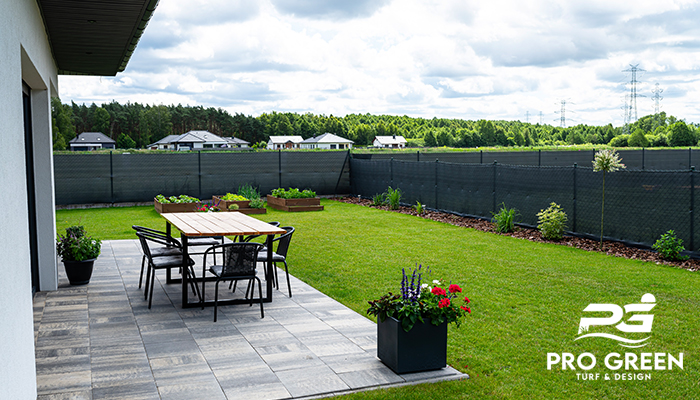
Absolutely. Many of our clients combine a hard-surface basketball court with surrounding artificial turf for a complete backyard recreation space. The turf stays green and lush year-round — even through BC’s wet winters — and requires minimal maintenance compared to natural grass.
Q: Is the installation done in one day?
For many of our turf and surface projects, installation can be completed within a single day with minimal disruption to your property. Basketball courts typically take a few days, depending on the scale and any required base work. We’ll give you a clear timeline before we start.
Q: How long has Pro Green Turf & Design been in business?
Pro Green Turf & Design has been serving BC homeowners and businesses for several years, building a strong reputation for quality workmanship, reliable project timelines, and outstanding customer service. We’re proud of our 5-star Google reviews and 150+ satisfied clients.
Ready to transform your outdoor space?
Get a free, no-obligation quote from Pro Green Turf & Design. Serving Vancouver, Langley, Surrey, Burnaby, Coquitlam & All Across BC progreenlandscape.ca | 604-442-5000 | info@progreenlandscape.ca